(CCU Fellow) In the 1960s the discipline of political science was becoming distressed by what they perceived to be an imbalance in the political system. Their impression was that interest groups, what they often called “pressure” groups, were becoming much more influential than political parties. In their view groups and parties had offset the goals of the Madisonian system which includes the aggregation of public opinion through compromise. What pressure groups wanted to do was disaggregate the populace into groups which could then successfully lobby Congress. The point of parties was to aggregate society into broad groups in order to win elections. One analyst, Theodore J. Lowi, went so far as to claim that hyper–pluralism existed: all groups who made requests upon government were accommodated. This was a very prescient view that has only been exacerbated. However, this may be changing.
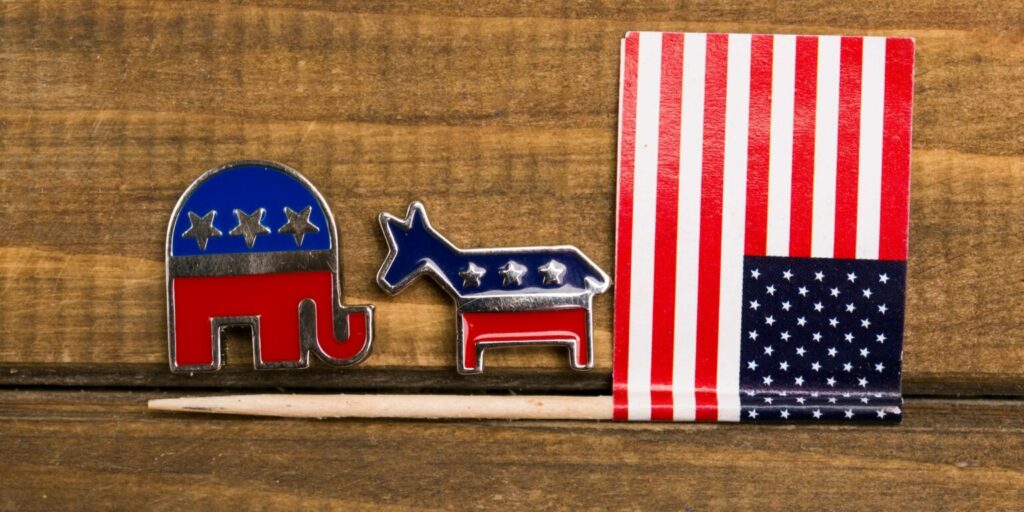
One of the voices in favor of a stronger party system was E. E. Schattschneider, in The Semisovereign People. Schattschneider’s argument was that people did not pay attention to politics at the national level; there were too many more important things going on in their daily lives and workplaces. For Schattschneider this meant there was little to no conflict between the parties. What the parties were aiming at were independents, the voters in the middle as opposed to the extremes. The idea was that strong or even weak Republicans would most likely if not always demonstrate their loyalty to their party by voting Republican and would not be dissuaded, except in the most extreme cases, by the other side. The same was true of strong and weak Democrats. Interestingly, there were what can be called extreme cases, e.g. Democrats for Reagan in 1984 or Republicans for Clinton in 1996. The fact remains that the majority of American elections hinge on the rather small percentage of independent votes in the middle of the spectrum.
This strategy changed approximately in the 1990s with Bill Clinton trying to increase the turnout of strong and weak Democrats, now called the base. Being that most American politics are like the NFL, copycats just reacting to the other side and not coming up with new or original ideas, the Republicans tried to strengthen the turnout of their base. The result of this has been a polarization of the electorate, something Madison could not have foresee. The far right and left wings of the spectrum of American politics have become much more powerful and much more vocal. The problem for the politician is that he also must maintain his appeal to the middle. Thus, the current president looks like a ping-pong ball being smacked back and forth between far left and the moderate center.
Is this good or bad? For Schattschneider it might be a good thing. For Schattschneider a good deal of the problem was that there was little to no conflict between the parties. His, and others, idea was to expand the scope of the conflict by making parties more distinct from each other, i.e. responsible parties. Responsible parties are those which are accountable to the people, have a mandate from the people and can exert party discipline on its members. This is not true of modern “irresponsible” parties. Because of separation of powers, parties and politicians are not actually accountable to the voters. One can always have one’s own view of the truth. But if one objectively tries to sort out, e.g. the current economic collapse by giving proof of specific credit or blame to the present or former president, Congress, etc., we come to a fork in the road and as Yogi Berra once said, when you come to a fork in the road take it.
Who or what is responsible for the bailouts? Obviously Bush started the TARP program. Wrong, obviously Obama he expanded bailouts way beyond our ability to pay. However, if you are a truly objective voter trying to assign credit and blame and cast a rational vote you cannot because economic issues do not occur neatly within administrations but over decades. Often times presidents in office place blame on the Congress, the opposition party, his own party, the bureaucracy, foreign affairs, ad infinitum. (The current president has a unique approach. He blames the American people themselves. Schattschneider is informative here making the argument that professors cannot flunk the people.) In fact this is true. If the essence of separation of powers is to bring about compromise then factually and objectively no president, Senate, House, congressional member, nor political party can actually take credit or get blame so that a rational voter can make a rational choice. Thus, there is no true accountability which is helpful to the voter.
One of the first things politicians do upon winning election is claim a mandate, an authoritative command or an authorization to act given to a representative. This claim of a mandate, except in extreme examples, e.g. Reagan in 1984, are fallacious. Because of the way elections are run we often times do not know what a candidate truly stands for much less what he will actually do. Radio and television ads seldom inform us of the party the candidate is a member of. Again, this is the logic of appealing to the independents in the middle. The result is that politicians do not know why the voters have sent them into office! So they generally make it up themselves. This is legitimate in the Burkean sense of representation wherein uninformed voters entrust a person of character, reputation, etc. to represent the people’s interests as he sees fit. This may intellectually solve the problem but it is a better fit in a parliamentary system than the American system.
The American system has evolved into a much more candidate centered politics in which we expect the candidate, irrespective of party, to follow our wishes. This is referred to as the delegate model of representation; politicians are there to follow the will of the people. The problem is, as outlined above, is there a will of the people? Here, the so-called crisis of rationality mitigates against the creation of a will of the people. The crisis of rationality states that rational party behavior leads to irrational voter behavior. The job of the rational party is to obfuscate the differences between the parties, appealing to independents in the middle. Voters then vote irrationally based on personal whim rather than casting a vote which influences the political system. Here, we vote for a candidate because he is good looking, she is black, he went to Harvard or the candidate just has beautiful children. These are irrational votes in the sense that they do not communicate a mandate to the candidate.
Lastly, there has been no party discipline in American politics. All politicians in America, save the presidential candidates once they pass the nomination phase, raise their own money, form their own staff, campaign on their own with little help or influence from the party. Thus, the rational politician, upon entering Congress, makes a rational calculation on all actions: will this help or hurt me to get reelected since the party, if I go along, is not going to benefit me very much. This explains much of the Democrat party’s refusal to follow resident Obama’s lead.
This leads to what might be the biggest campaign lie in all of American politics. The next time you hear any candidate say “if elected I will” they are either lying because with separation of powers they cannot guarantee anything, or they are ignorant of the theory of the American government. Thus, especially at the presidential level, the result is heightened expectations which can never be fulfilled, guaranteeing failure. The American people are only semisovereign because while our votes exhibit our sovereignty, in fact we have no control over the process or the system. “If politics is not competitive the people are powerless.” (Schattschneider, 137) Note the number of noncompetitive seats in the House of Representatives.
On the bright side we might be unknowingly developing Aresponsible parties.@ Pres. Obama is easily the most liberal candidate from a major party America has ever had. Interestingly, Bill Clinton was the most conservative Democratic president of the last century. The House has a majority of Republicans and presents as a very conservative body. The Senate is less so. It is becoming a bit easier for the informed rational voter to hold one side or the other accountable for their actions. Certainly what has developed is, in Schattschneider’s terms, a contagion of conflict. The conflict between the two parties has become like a fight at the flagpole in grade school after class. Everyone runs out to watch. It is then, at least according to Schattschneider, human nature to take sides. The conflict in American politics might seem like a fifth-grade squabble, cf. the kerfuffle over raising the debt limit. But it got people to pay attention to the American government, often in spite of themselves. These voters are then taking sides and can hold politicians and parties accountable. To extend the theory, the next election cycle should have politicians running under the umbrella of their party, uniting under a set of principles be it conservative or liberal. The winner will have a mandate, in this case speaking generally, bigger or smaller government. If the party is elected on this mandate of bigger or smaller government, the politicians in the House and the Senate will also be elected by that same criteria. Thus, the ability to enforce party discipline will be greatly enhanced. We will have responsible parties, greatly reducing the influence of the pressure system.
The downside. This theory assumes a certain type of democracy, “Democracy is a competitive political system in which competing leaders and organization define the alternative of public policy in such a way that the public can participate in the decision–making process.” (Schattschneider, 137). What is the problem? As always, as James Madison knew well, in the American political system there is always the possibility of tyranny. Madison’s definition of tyranny was government taking sides, not being neutral as a result of compromise. Especially if we have one party government, which seems likely in the near future, we must maintain a rigorous adherence to separation of powers.