In recent years, American conservatism has undergone a significant transformation. The rise of populist rhetoric, economic protectionism and an increasing reliance on executive authority has marked a departure from the philosophical roots that once defined the conservative movement.
To chart a stable and principled future, conservatism must return to its foundational thinkers—Russell Kirk, William F. Buckley Jr., and Ronald Reagan—whose ideas emphasized limited government, ordered liberty, free markets and moral tradition. These principles, not transient political trends, provide the enduring framework for a coherent conservative vision.
Russell Kirk, in The Conservative Mind, set forth a philosophy grounded in the “permanent things”—the inherited customs, moral truths and institutions that give shape and continuity to society. For Kirk, conservatism is not merely a policy checklist but a disposition: a recognition of human fallibility, a reverence for tradition and a skepticism of sweeping government action.
“The conservative,” Kirk wrote, “endeavors to so limit and balance political power that anarchy or tyranny may not arise.”
This stance is a stark contrast to the recent embrace of executive overreach and a centralized administrative state by some on the right. Rather than resisting the growth of unchecked federal power, modern populist conservatism often seeks to wield it in the service of partisan goals, undermining the very restraint that Kirk saw as essential to liberty.
William F. Buckley Jr., founder of National Review, provided the intellectual and political engine for postwar conservatism by uniting traditionalists, libertarians and anti-communists under a shared banner.
Buckley insisted that conservatism must be “standing athwart history, yelling Stop,” not in a reactionary way, but as a defense of enduring truths against the tide of utopian progressivism. He championed a fusionist conservatism that respected individual freedom, free markets and moral order. Today’s flirtation with protectionism and industrial policy abandons this legacy. Tariffs, government subsidies, and economic nationalism are not conservative responses to globalization—they are distortions of the market and betrayals of the entrepreneurial spirit that Buckley and his generation defended.
As Buckley understood, economic freedom is inseparable from political freedom; both must be preserved from the encroachments of state planning.
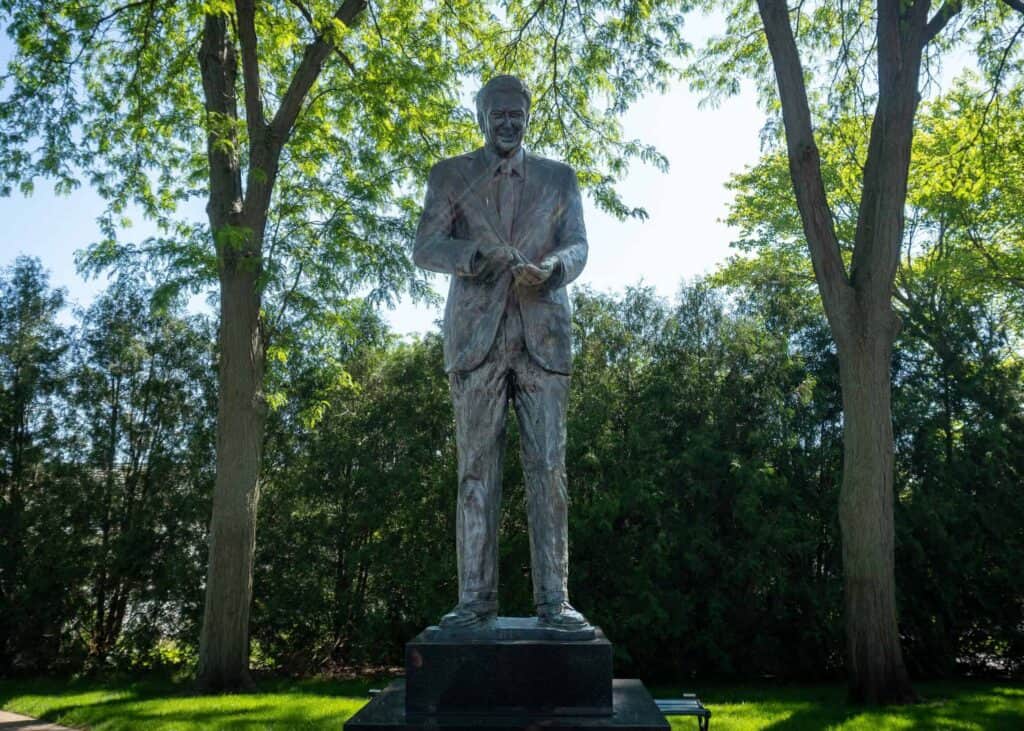
Ronald Reagan brought these conservative ideals to the forefront of American politics with clarity and optimism. “The nine most terrifying words in the English language,” he famously said, “are: I’m from the government and I’m here to help.”
Reagan’s approach was grounded in faith in the American people rather than centralized bureaucracy. He believed in lowering taxes, limiting government, promoting free trade and projecting American strength abroad through moral clarity rather than ideological fervor. While Reagan could be pragmatic, his policies reflected deep-seated principles rather than populist impulses. His vision of a “shining city on a hill” evoked not tribal grievance, but national purpose rooted in liberty and civic virtue.
By contrast, today’s populist conservative movement often eschews principle for power. It elevates loyalty over deliberation, grievances over governance and coercion over persuasion. The recent turn toward economic nationalism, hostility to immigration, and disdain for traditional alliances marks a rejection not only of Reagan’s internationalism but also of the foundational conservative belief in human dignity and the rule of law.
Furthermore, the embrace of big-government solutions to cultural and economic problems—whether through federal mandates, sweeping bans or executive fiat—reflects a progressive faith in state power rather than a conservative humility about its limits.
The traditional conservative framework offers a more sustainable alternative. It is rooted not in the volatility of populist sentiment, but in enduring principles tested by time. It acknowledges the importance of custom, the rule of law and the mediating institutions—families, churches, local communities—that form the bedrock of civil society. It seeks reform, not revolution; persuasion, not imposition.
In reclaiming the legacy of Kirk, Buckley and Reagan, conservatives can once again champion a movement not defined by short-term victories or ideological purges, but by a commitment to liberty, order and virtue. This does not mean ignoring the real concerns that fuel populist discontent—such as economic dislocation and cultural fragmentation—but addressing them through the lens of constitutional restraint, free enterprise and civic renewal. Conservatism must offer more than opposition; it must articulate a coherent vision of the good society rooted in the American tradition.
Only by returning to its philosophical roots can conservatism avoid becoming a hollow vessel for political opportunism. The path forward is not through more government, more division or more power at the top—it is through principle, prudence and a recovery of the permanent things.
Greg Schaller serves as the director of the Centennial Institute, the conservative think tank of Colorado Christian University. He has taught politics at CCU, Villanova University and St. Joseph’s University. He holds a B.A. in political science and history from Eastern University and an M.A. in political science from Villanova University.